When I first started therapy, I had a conversation with my therapist that surrounded a recent hip surgery I had gone through in the fall of 2018. I told her that I’m trying to – and hope others will as well – start seeing the rehabilitation of my brain as the same process for rehabilitating my hip. I attacked those PT exercises with such vigor, such intensity, that I said to myself that when I get into that follow up PT session with my doctor, there is not going to be a single doubt in his mind how hard I worked at those leg raises and stretches. I wasn’t going to leave anything to chance…if my hip didn’t heal for some odd reason, it for damn sure wasn’t going to be for lack of trying and lack of effort. So, during this conversation, and from then on, I’ve tried to see my mental health in relation to physical health – one, because they are so, so connected, and two, because your mental health, while not visible, I now believe holds the secret to every other piece of health in your body.
I first started going to therapy when I was diagnosed with Anorexia in the Spring of 2003, while finishing up 8th grade. At the time, I had no idea what it was. Talking to people? OK, sure. What do you want to know? Why am I not eating? I’m not sure, you tell me please…isn’t that why my mom is paying you? That’s a little harsh, but also part of the mindset of someone being 14. In hindsight, therapy is interesting at that age because you, as an adolescent, aren’t aware of your own thoughts or habits and how they may be impacting you and the decisions you make. Therapists and psychiatrists obviously know this, but it just begs the question of “man, if I had just the slightest inclination of the thought processes behind the reasons why I wasn’t eating, maybe there could have been a different outcome?” Or, at least, an outcome that wasn’t so serious? More on the details of that in later posts. My point being is that mental health is such an important aspect to our overall daily lives, that I feel it’s important to have yourself introduced to the subject early on in life.
From that point, I went through various forms of therapy while the depth of my eating disorder ran its course, and tapered out of therapy going into 9th grade once things had settled down on the eating disorder front. From then on, I didn’t see a therapist until I found my current one, Jennifer, in early 2020. In hindsight, there were many times where I was close to seeking help, or times where it would have been a good idea to find help, and I chose not to. I believe the main reason for this is that therapy is TOUGH. It’s hard and uncomfortable. It sometimes gets worse before it gets better. It makes you confront demons you didn’t know were there, and emotions that you didn’t know you had. It’s WORK. I say that not to scare anyone away, rather, I say it because if you can allow yourself to be uncomfortable with that dynamic, you – ironically? – will be happier for it in the long run. There’s a quote in a book I love (The Body Keeps the Score) that notes, “The job of therapists is to help people acknowledge, experience, and bear the reality of life”…and it goes on to say that “The greatest sources of our suffering are the lies we tell ourselves.” Essentially, if you can start to acknowledge the hard truths in your life, talk to someone about them, see that it’s NORMAL to have these hardships, and reorient the narratives around them, you will be much happier. That I promise. Feeling tough emotions and tough truths, while negative in the midst of them, makes you happier in the long run.
We as a society struggle with mental health. I believe most of us are probably aware of that. And part of me understands why…it’s an unknown…the brain is SO complex, infinitely elastic; there are likely pieces to it that we may never understand in our lifetime, or the next. And anything we humans don’t understand, we typically tend to shy away from. It’s human nature. I’m in the same boat…I wouldn’t talk to others about my eating disorder – at least talk about it with any form of substance – on/off throughout high school and college because I didn’t understand it…it’s big and scary and weird and makes me not eat…how am I supposed to interact with something like that? The same goes for <INSERT MOST MENTAL HEALTH DIAGNOSES>…we don’t know them and can’t see them, therefore they’re foreign, and therefore they’re untouchable. However, if we, as humans, can accept that fear & feelings of being uncomfortable that come along with addressing these conditions – not push it away, but accept that it will be there, and see what you can learn from that fear – we can start to change. And if we can change, rather, if we can reorient our mindset as a culture around mental health, I believe a lot of the pain and suffering that we as humans endure can start to become softer.
I do want to tell one story that may give some insight into how important mental health is to your overall physical health and overall well being. Starting in 2012, I started to develop regular stomach aches that I attributed to a dairy intolerance…these continued until about mid-2020, and essentially became chronic in that time span. Additionally, in late 2017, I started to develop some pretty bad shoulder pain that would vary in its intensity and location – it would be just around my shoulder blade and dull, or it would encompass my entire right shoulder, upper back, and relay down to my right elbow – basically rendering my arm unable to pick up a carry-on suitcase and put it into the overhead bin. (If you ever want to feel old as a 29 year old, try watching the 60 year old lady in front of you pick up her suitcase with ease while you can barely lift your arm.) Fast forward to mid-2020, about four months into regular, dedicated, well-received therapy, and I find out I’m not lactose-intolerant, and my right shoulder pain is gone – completely. Stomach aches = from stress & anxiety (and a bit too much coffee, oops). Shoulder pain = in very general terms, the right side of the brain houses some of the more negative emotions (and is the “emotional” side of the brain)…disgust, fear, anxiety. What I realized during therapy was that I had suppressed so many of these emotions that the weight of that was carried all throughout the entire right side of my shoulder and back. To this day, if I’m carrying a decent amount of fear or anxiety, my shoulder acts up a little bit. This isn’t foolproof – I also do a huge amount of physical activity that contributes to some things, but the correlations between these items I noted above is too strong to not have a connection. (Also a reason that the book mentioned before is aptly titled, The Body Keeps the Score). The moral of the story is that practicing good mental health strategies can work wonders that you may not even realize and it might just unlock some secrets to living a more wholehearted life.
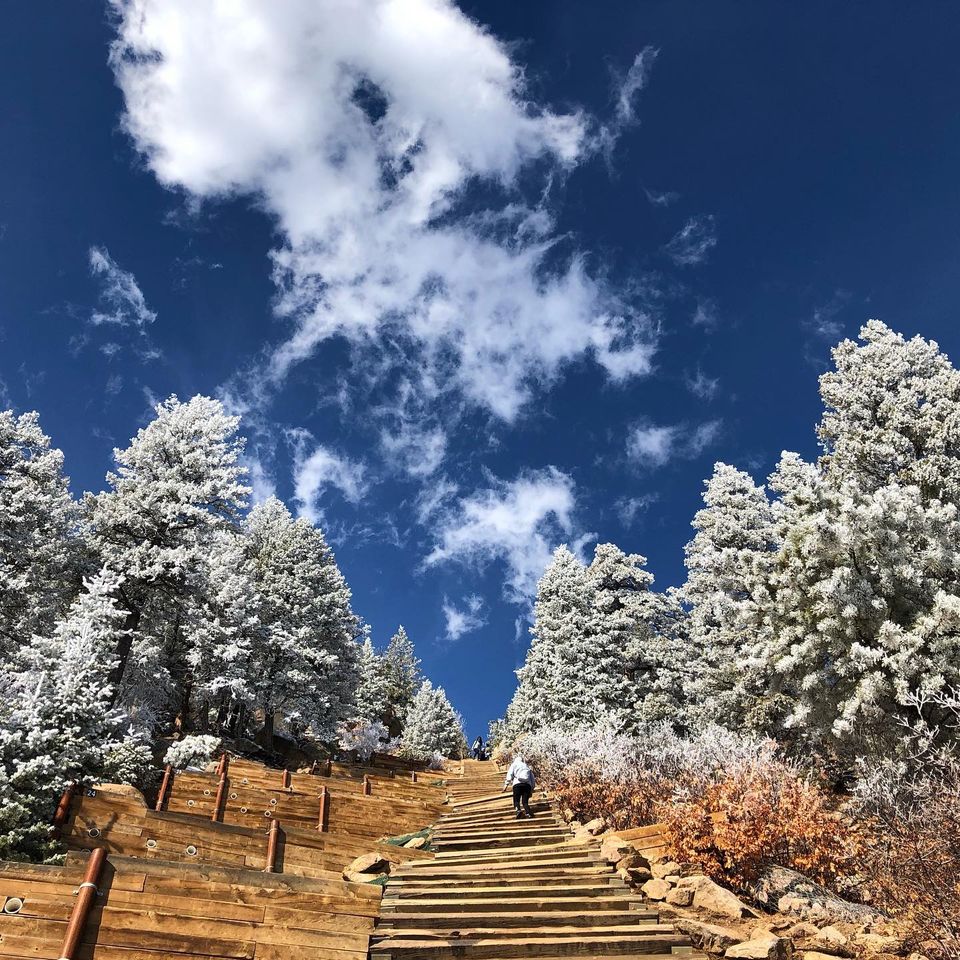
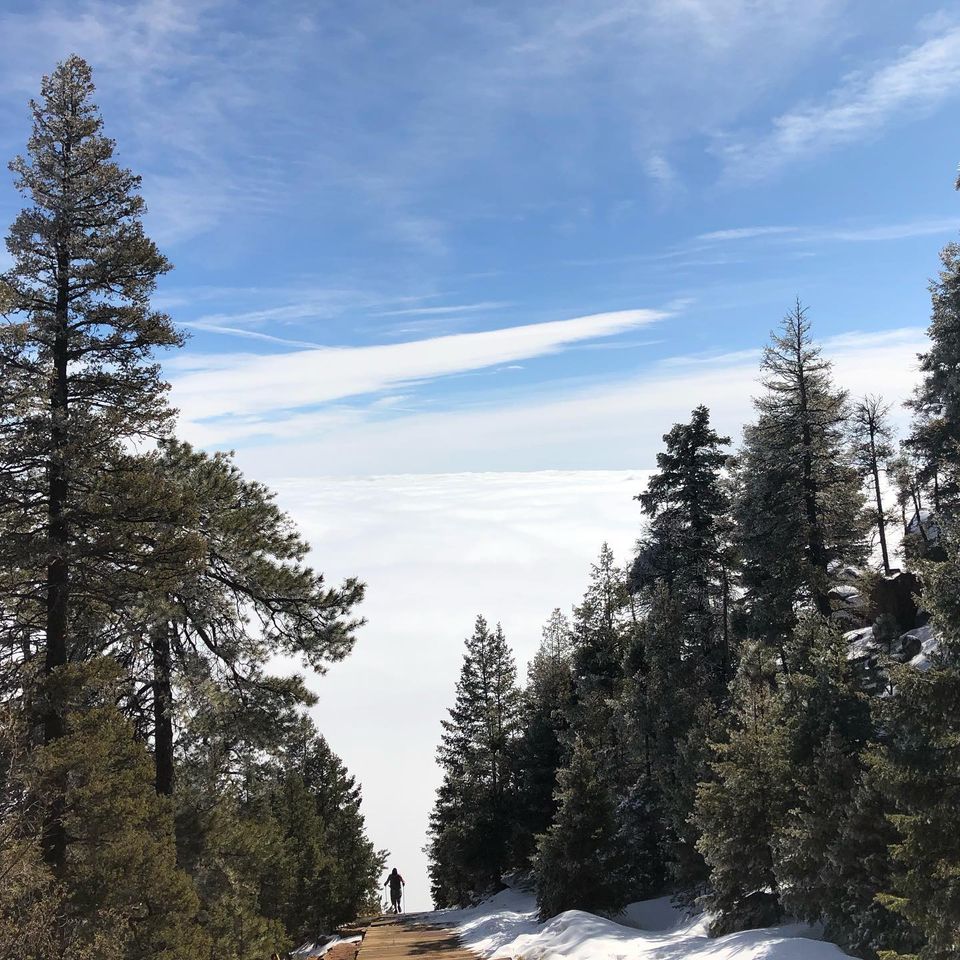
Before I go, I wanted to push out some inspiration for anyone who’s having a hard time. The above and below photos are of the Manitou Incline located here in Manitou Springs (adjacent to Colorado Springs). For those of you not familiar with this fun little adventure, it’s an old cog railway bed that is now a vertical staircase totaling about 1 mile in length and 2000′ of vertical gain. It’s a slog of a workout, Type II fun at its finest.
To set the scene a little better, the town of Colorado Springs lies underneath that cloud deck – the deck was so low on this day that you started below it, climbed up through it, and then rose above it.
On this particular day, I had just taken two weeks off of work to figure out what was going on in my head and why I was having so much anxiety and fear. To get healthy. My dad was out in Colorado (to help get me healthy), and I moved into a new house. Leading up to this, it truly felt like a low point in my life. How do you get to a point where you can’t even be present at work? How can you barely muster the energy to make it through the day, but then not sleep at night? Why do I feel like I’m broken? These were all questions that ruminated in my mind during that time. Throughout this hike however, I finally realized that if you can just muster the energy to start…even if you’re below the cloud deck, where you can’t see up, you realize after you take a few steps, you’re in the cloud deck where things are just foggy – a mess, chaos, emotional, HARD – but if you keep moving forward, you soon see that you’re above it. And FUCK. Look at those views. Isn’t that worth the hard steps? Keep the faith everyone, keep pushing, keep sitting with the hard things, keep doing what makes you happy, and you will get to that view. It might not be tomorrow, or next month, or even this year, but it will come.
Bye for now.
Matt

 The Search for Gratitude
I could hear your voice throughout the post. Your 14 year old voice, 18 year old voice and your current voice. Your words are so genuine. Proud of you.
Therapy is hard! Keep up the good work!
LikeLike
Thank you!
LikeLike
Matt! These posts continue to inspire me! I can’t wait to read the next one! Stay awesome, Matt! Thanks for doing this!
LikeLike
I’m so glad you enjoy them!
LikeLike